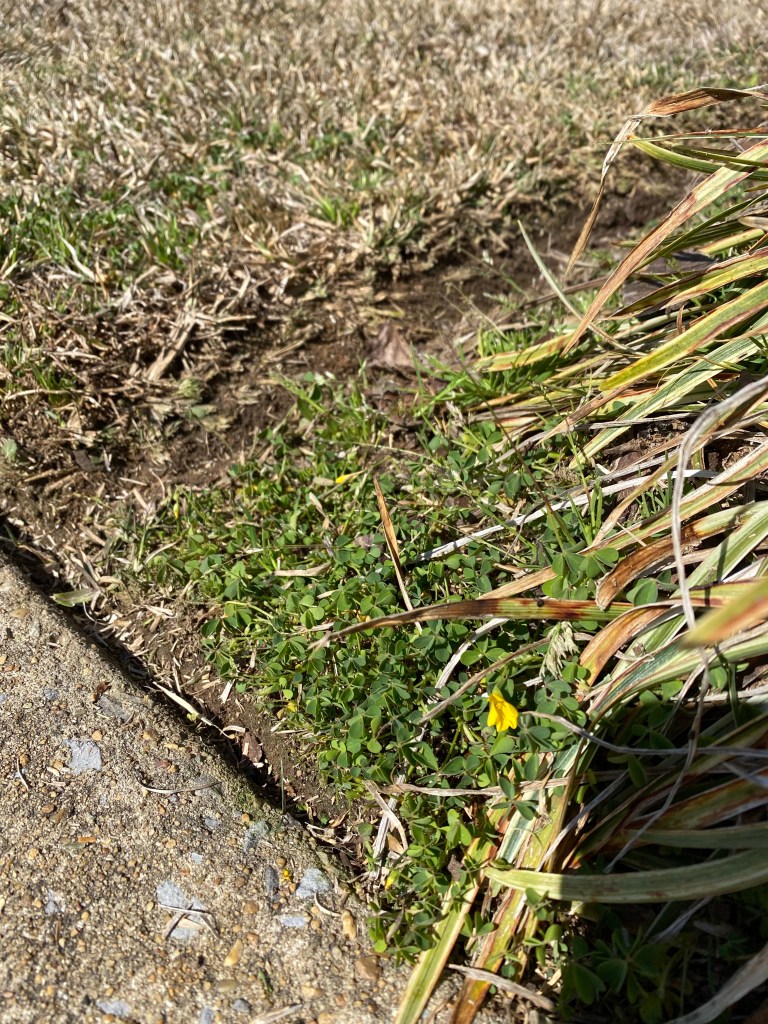
Wintertime Weeds

Last week, we “sprung forward,” so spring is just around the corner, right?!?

More daylight and warmer temperatures are the perfect opportunity to get out in the yard after taking the winter off. There was no need to mow and I strongly dislike raking, so very little was done in the yard for the past four months or so. No big deal, right?

Oh, how quickly we forget. The last time the grass was mowed last fall, it was edged, even, and (so I thought)…….weedless. Last week, there were a few sprigs of green grass trying to break through – but the most evident arrival was that of the weeds. In the yard. Around the mailbox. Among the mulch and the shrubs. WHERE DID YOU COME FROM AND WHO INVITED YOU? Asking for a friend.

I visited this website and was welcomed by the following quote: “Not everything goes dormant in the wintertime. Winter weeds are thriving and will wreak havoc in your garden. Be sure you’re prepared.” There’s much more to this statement than what you’ll see in your yard. That is applicable in life, too.

When you think of the word “winter,” what comes to mind? Here are a few words that immediately surfaced: Cold. Sweatpants. Fires. Soup. Gloves. Hibernate. Rest. Less daylight. None of those words really drive me towards a ton of activity; instead, “winter” lends itself to a focus on rest and recovery.

While all of us need “seasons” of rest in our lives, moving to a complete state of ignoring or avoiding will potentially lead to the unwanted arrival of “weeds” in our lives. Think about how quickly “weeds” can pop up in (or take over) our thought lives, our families, our marriages, our finances, our friendships, our work places, our ministries, our health, our dreams, our neighborhoods, and our Spiritual walks. “Not everything goes dormant in the wintertime.” Warning: our failure to acknowledge the presence of weeds does not eliminate their existence.

When we have taken four months off from anything, how can we expect things to just “maintain” the state at which we left them? If I don’t workout for four months, I’ll lose muscle. I’ll lose stamina. I’ll lose motivation. There is NO WAY I can walk back into the gym four months later and just pick back up as if I’d never left. Nope. I’ll be backing down on the weight to gradually build up again. I’ve let weeds move in. If I disconnect from personal growth in my Spiritual walk, I’ll likely find that I’ve become disinterested in and uncommitted to the things that help me grow and stay healthy (Bible reading/study, prayer, fellowship, serving, praise and worship). I’ve allowed weeds to move in.

Question for us to ponder: Why is it that we can easily find ourselves questioning “how the weeds got here” when we’ve done little to nothing to keep them out? In terms of the yard, do you ever find yourself complaining because “these weeds wouldn’t be here if the neighbor would just take care of their yard?” If we find it easy to cast blame on our neighbor every time a weed appears in our yard, do we equally give them all of the credit when our yard looks beautiful?

I can’t help but think of the Parable of the Talents. Two of the men took responsibility for their “talents” – what was entrusted to them – and they made much of them. One man, however, took no responsibility and simply cast blame for what he didn’t do. Sounds to me like he had some weeds in his yard, too. Must’ve been the neighbor!!!

No, I don’t like cold weather.

No, I don’t like raking.

No, I did not tend to my yard for four months.

Yes, I do love to have a thick, lush, green lawn full of grass…..not weeds.

My three excuses contradict my one desired outcome. I was dormant…..the weeds were not. Time to get back to work!

Two Years Later.

The afternoon of March 13, 2020 is crystal clear and a blur at the same time. It was a Friday afternoon and educators in Tuscaloosa County were excited about finishing the day and heading out for spring break……except an announcement came that changed everyone’s plans.

Little did we know that Friday afternoon that school would not actually resume until August of 2020 and that we would become very acquainted with technology to help us stay connected to our students, friends, and families. COVID-19 was here.

Masks.

Lysol/Clorox wipes.

Social distancing.

Fear.

Shortages.

Loss.

Quarantining.

All of the sudden, a handful of words rose to the top of our “most used” list and life, as we knew it that Friday would forever be changed.

Over the past two years, we’ve been on a roller coaster that has yet to end. There have been some small upward peaks and some very significant – and scary – drops. The question I ponder two years in is this…..what have we learned?

For a period of time, we valued the “heroes” who were first responders showing up for work every day to keep us safe and well in the midst of a pandemic. Walk into a hospital now. Is it still the same?

For a period of time, we learned the value of relationship and reached out to friends and loved ones when we didn’t know when we could see them again. How about now?

For a period of time, we returned to an emphasis of prayer….acknowledging our inability to “fix” the problem and our need to desperately cry out to God and ask for His involvement in changing the circumstances. How about now?

Years ago, our church was hosting a sermon series called “At the Movies.” That year, September 11 actually fell on a Sunday and we watched/learned from the movie “Flight 93.” One of the quotes that stood out to me the most and sticks with me today is this: “Crisis is a great editor.”

Crisis can quickly “burn away the chaff.” It can easily reveal what should get your time and attention and what should take a backseat. It can easily reveal what’s in your heart – even if that doesn’t align with your words.

My question for me – and maybe for you, if you’ll entertain it – is…..what have I learned? How has this two-year journey shaped me and changed me for the good? And maybe the not-so-good?

Today is a great time to reflect. Help us, Lord, not miss it. Help us not return to the less important things at the sake of the most important things. There’s been too much loss to forget what we need to have remembered.

Altars of Remembrance

The Lord appeared to Abram and said, “To your offspring I will give this land.” So he built an altar there to the Lord,who had appeared to him. From there he went on toward the hills east of Bethel and pitched his tent, with Bethel on the west and Ai on the east. There he built an altar to the Lord and called on the name of the Lord. Genesis 12:7-8

There are so many mentions of altars in Scripture. Like the one mentioned above, altars often represented a personal encounter with God. The altar was built AFTER the encounter to serve as a reminder of what happened there. Because people tend to travel by the same places and pathways, the altars then served as a reminder of that encounter when that place was passed in the future.

There’s a lot that can be followed in the story of Abram. Many encounters with God. Many times he remembered the Lord’s goodness. Other times when he took things into his own hands to manipulate the outcome. Isn’t it awesome to think that even when we try to play the hand of God, it doesn’t change who He is? When things work out as we wish, He is still the same God. When things go completely opposite of anything we’d ever wish….He is still the same God. The altars of remembrance don’t disappear when we don’t get our way. In fact, that’s probably when they become the most meaningful.

November of 2016 was one of the most difficult months in my life. The Clifs Notes version will tell you that my dad had a ruptured aneurysm, had to be airlifted to a hospital in Mississippi, and that began a journey of surgeries and rehabs and successes and struggles. The Neuro ICU can be a lonely place. Yes, there are nurses buzzing around taking care of patients, doctors rounding with medical students, housekeeping coming through to keep things tidy and the nutrition team making sure the patients are well fed. Even when i was surrounded by people, including my dad lying in the hospital bed, I was alone.

In the midst of all of that, though, I got to build some altars. Linda was my dad’s first nurse. In the beginning, we had no idea if dad would wake up or what he would be like if/when he did. I was scared. But God sent a nurse named Linda (my mom’s name) to remind me that He was with us. Hannah was one of my dad’s nurses in the Neuro ICU. Her mother had the same type of aneurysm as dad and she became a nurse in THAT unit because she helped nurse her mom back to full health and wanted to do the same for people like her mom.

Friends and family members drove over to Mississippi to offer support, comfort, and presence. My husband stayed in town to take care of the kids and keep their routines as normal as possible. While I was away, friends back home helped provide meals to my family and care for my kids. One friend rode to MS with me that dreadful night because we didn’t think dad was going to make it and she refused to let me do that alone. A friend from college who lived in the area helped get my aunt to the airport so she could fly back to Cleveland. There are so many things that happened that I am just truly grateful for.

So why the reflection now? Almost five years later?

In August, I got to travel to Arkansas to present to the El Dorado School District. The way I drove to Arkansas was through Mississippi. Jackson, Mississippi. Home of the University of Mississippi Medical Center where Dr. Chad Washington and team saved my dad’s life. Home of moments of brokenness and peace and fear and celebration. As I drove through, I remembered each hotel I stayed in during my time there. The meals I ate at Cracker Barrel. And the coffee I picked up each morning at Dunkin’ before heading to the hospital. After we presented in Arkansas, I drove back home. Through Mississippi. Jackson, Mississippi. Home of the University of Mississippi Medical Center. Home of Sal and Mookie’s pizza joint. Home of Cups Espresso Cafe. Home of prayers answered and dependence on the Lord established.

The awesome thing was that my friend and co-worker Cheryl was on that trip with me. As we drove back through Jackson on the way home, I got to tell her all about God’s provision for my family in that city.

A lot has happened since November of 2016. A lot has been good. A lot has been really, really hard. Those hard times could easily cause me to forget. So, Lord, thank you for choosing the hard days of August 2021 to drive me back through Jackson, Mississippi…..twice……so that I would remember. You’ve been with me through it all.

Prefixes Matter.

One year and one week ago, a man who was a stranger to most of us lost his life. His name is George Floyd. In the 372 days since then, we have all had a lot of time to process. To evaluate. To change. Or to stay the same.

In the weeks following Mr. Floyd’s death, I watched a message by Andy Stanley called “This Human Race.” His message provided a very truthful and heartfelt message on racism in our country. One of the concepts that challenged me the most was that of being NON-racist or ANTI-racist.

According to my good friend, Merriam Webster, the prefix “Non-“ means “not; other than; reverse of; absence of.” Merriam Webster also defines the prefix “Anti-“ as “exerting energy in the opposite direction, one that is opposite in kind to, opposing in effect or activity, or serving to prevent, cure, or alleviate.”

Those words are only one letter apart but they couldn’t be more different. Let me explain as Andy Stanley did and with the application of Merriam Webster’s definitions.

I can easily say I’m NON-child abuse because I don’t abuse my children. If I see it happening, I can walk by and think, “I’m non-child abuse because I don’t do that to my children.” However, if I’m ANTI-child abuse, I cannot simply walk by undisturbed and proud that “I don’t do that.” Instead, what is happening is so disruptive to my spirit that it requires a response. An action. Not an internal evaluation of how good I think I am.

Over the past year, I have had the privilege to engage in some extremely difficult conversations with people who have grown more precious to me than I could have imagined. These conversations didn’t happen because life was great. They happened because of very hard situations that involved racism. Those situations brought things to surface that these friends have had to deal with their entire lives because of the color of their skin.

Please hear my heart when I say this: I am NOT making a political statement. I am so far over the political climate in our country that I don’t care what “side” you voted for or where your political preferences lie. What I do know is that until we take ownership for OUR OWN responses and quit throwing out very general “they” statements to blame everyone else, we will never make progress. Not as individuals and certainly not as a nation. A political party will never change your heart. (But Jesus can.)

That being said, I’ve sat across the table from friends who were told they were the hardest working people at the business but they couldn’t be promoted because the owner “didn’t want black people out front.” I’ve listened to stories about parents who train their black sons how to respond if they were ever to be pulled over by law enforcement – and I’ve never even considered that to be a necessary conversation with my white son. I’ve learned about a friend close to my age who was seated on one side of the math classroom with her four black classmates while the teacher turned her back to them and taught the rest of the white students – the entire year. I don’t know if this brings a rise in you – but I can tell you that these are no longer just stories I’ve heard but they are areas of hurt in the lives of people I love. What hurts them hurts me.

In October of 2020, I got to visit First African Baptist Church in Tuscaloosa, Alabama. This was the site of a horrible event called Bloody Tuesday. It all happened on June 9, 1964. A group of African Americans wanted to march from the church to the nearby courthouse simply to get a drink of water out of the same fountains white people used. As they marched down the front steps of the building, many were attacked and repeatedly beaten by local law enforcement officers. One of those men was Mr. Maxie Thomas, seen in the freshly starched denim pants below.

(L-R) Danny Steele, Maxie Thomas, Dr. Scott Bridges)

At the time, Mr. Maxie had recently returned from serving in the Vietnam War. His willingness to serve our country at that time meant that he left his family behind as he volunteered to offer his life to fight for your freedom and my freedom yet return to Tuscaloosa and find the freedom he fought for was not offered to him. He actually took the brunt of a brutal attack as he protected a female marcher.

Mr. Maxie Thomas lies on the ground after being beaten in the face with a billy club.

Mr. Maxie spoke to us that October afternoon – and, as a man who suffered immensely because of the color of his skin, he challenged us by repeatedly saying, “We CAN overcome because we are all a part of the Human Race.” His words continue to resonate with me every single morning as I look in the mirror.

This. Human. Race.

Non-?

Anti-?

You choose.

BOUNDARIES

I played volleyball in high school. The court was very clearly defined – usually by some dark and bold color of paint. During a volleyball match, a line judge is placed an two corners of the court…the corners opposite of where a player stands to serve. The line judge is given a flag and is asked to identify a few game-changing things:

1. Did a player touch the ball before it went out of bounds?

2. Did the ball land INside of the lines marking the court?

3. Did the ball land OUTside of the lines marking the court?

Sometimes, the line judge’s job was extremely easy. The player very blatantly touched the ball, the ball very plainly landed inside the court, or the ball very plainly flew out of bounds. You could be guaranteed that if the ball landed close to the line….the arguing would begin. Apparently, when things are close, people argue as of the boundary lines should change.

Merriam-Webster defines a boundary as “something that indicates or fixes a limit or extent.” we may refer to a boundary as a border, an edge, a frame, or a margin. Whichever word you choose, there’s no doubt that a boundary line represents what is in bounds and what is out of bounds……and boundaries don’t typically move.

My friend, Mary Leach, invited me to read a devotion on the YouVersion app and it’s called “Boundaries 101.” (Check out Mary’s blog Here!) as we started on day one, these words screamed at me: “In addition to showing us what we ARE responsible for, boundaries help us to define what is NOT on our property and what we are NOT responsible for.”

As I read those words, I immediately looked down at the red rash that is still present at the base of both of my legs. Two weeks ago, I was working in the yard. Edging. Weedeating. Mowing. Cleaning up. As I began mowing, I noticed some overgrowth that was…..technically…..on my neighbor’s property, but growing up MY fence. In my mind, it would be helpful to them if I grabbed the weed eater and took care of it….and it would uncover part of the fence we recently spend a lot of money having installed. All was well when I finished and the yard looked great. That was Saturday. About 18 hours later, my legs were covered in blisters….that itched….and, quite honestly, looked horrible. I immediately had to call an audible on what I was going to wear to church and even had to change my plan for shoes because of the presence of my friend….Poison Ivy.

When we bought our home, there were stakes in the yard to show our property lines. What’s inside of those lines belongs to us….and we are responsible for taking care of it. What’s outside of those lines? Not our responsibility. Not to do ourselves. Not to tel others that it’s not being done. Our property lines – boundaries – give us clear cut direction on how to run in our lane.

Disrespecting the boundaries brought poison into my life. (Please don’t misread that as I wanted my neighbor to get it. We have roundup. 😊) All because I saw something in someone else’s boundaries that I wanted to address….and I thought it would “help” them (or just make my yard look better, truth be told) for me to do it. The result was painful.

What line judge are we looking to as the source of what’s in and what’s out?

-My preferences?

-What makes ME comfortable?

-What a certain group of people prefers? (Family, friends, political parties, media, whomever is influential in our lives at the moment)

-The unchanging Word of God?

When we allow God’s Word to truly draw the boundaries, we don’t have to challenge them. We don’t have to step outside of His design and find ourselves covered in poison ivy. We really can avoid a lot of pain when we choose to live inside the safety of His boundaries.

It’s game time! Grab your knee pads, listen for the whistle, and put the ball in play! Keep your eyes on the Line Judge….and stay inbounds.